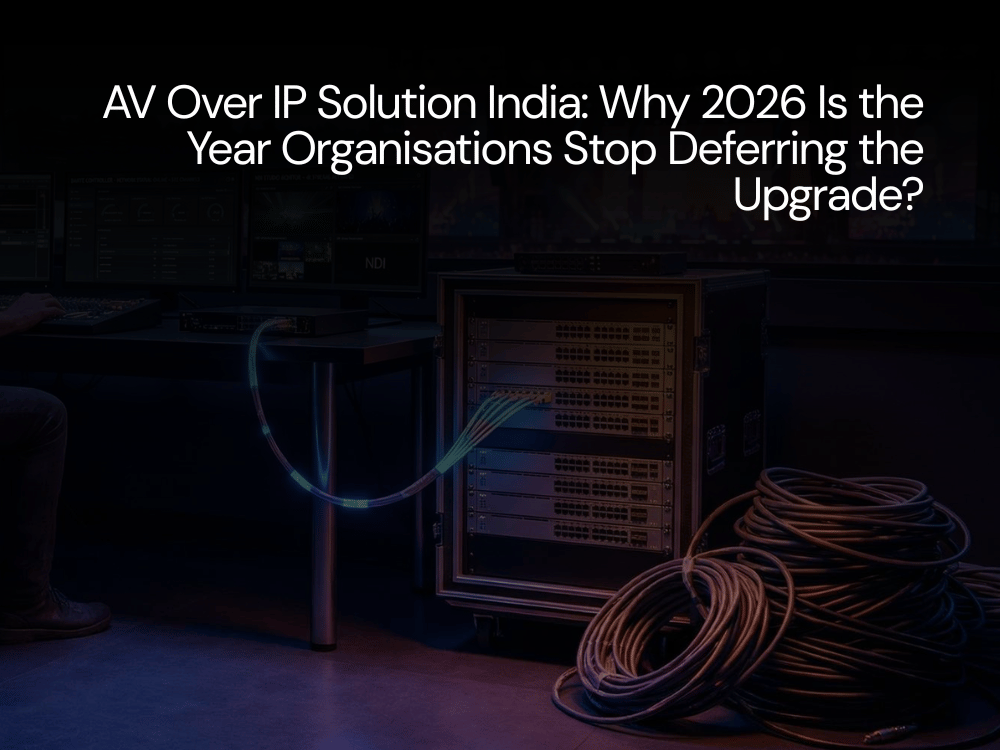
If you have ever been in a modern control room, a well-run broadcast facility, or a corporate campus that genuinely works — where screens show exactly what they need to show, signals appear and disappear without ceremony, and no one is running cables under desks in the middle of a meeting — you have probably been in the presence of an AV over IP infrastructure, even if no one called it that.
AV over IP is not a new idea. But it is having a moment.
The global market for AV over IP solutions was valued at approximately $1.5 billion in 2024 and is projected to reach $4.5 billion by 2033, growing at a compound annual rate of over 15%. Asia-Pacific, driven in large part by India’s smart infrastructure buildout and enterprise digital transformation, is among the fastest-growing regions in this expansion.
The question for Indian organisations — enterprise campuses, government command centres, defence facilities, airports, universities — is no longer whether to transition from traditional AV distribution to an IP-based architecture. The question is: why haven’t you yet, and what happens if you wait much longer?
What AV Over IP Actually Means (Without the Jargon)?
Traditional AV distribution runs dedicated cables from each source to each display. A meeting room with four inputs and one screen requires four HDMI cables routed through walls, terminated at precise lengths, with each run limited to roughly five metres for full 4K quality unless you are using costly extenders. Scale this to a 50-room corporate campus or a 200-monitor control room, and you have a cabling infrastructure that is expensive to install, rigid to reconfigure, and a maintenance burden every time a screen or source is added or moved.
AV over IP takes a different approach entirely. Video and audio signals are encoded, transmitted across standard network infrastructure — the same ethernet switches and fibre that already exist in your building — and decoded at the destination display. Any source can go to any screen. Layouts change with software. A new display requires a network port, not a dedicated cable run. The entire system is managed from a single interface.
The result is an AV infrastructure that behaves more like an IT infrastructure — scalable, flexible, remotely manageable, and built for how organisations actually evolve over time rather than how they were configured on the day of installation.
Why the Timing Is Right for India in 2026?
Several things are converging in 2026 that make this the right moment for Indian organisations to invest in AV over IP.
- Network infrastructure maturity. The premise of AV over IP — that your existing network can carry high-quality video — is only true if your network is capable. Five years ago, many Indian enterprise and government networks were not. That has changed dramatically. The rollout of 10-gigabit switched network infrastructure across corporate campuses, government buildings, and data centres means that the backbone for AV over IP already exists in most modern facilities.
- 4K demand is now real, not theoretical. Surveillance cameras, medical imaging feeds, engineering visualisation software, satellite data streams — the content that organisations need to display has genuinely moved to 4K resolution. Legacy HDMI distribution infrastructure was not designed for 4K at scale. An AV over IP solution with uncompressed 4K capability handles this natively.
- The hybrid work shift changed what conference rooms need. A conference room designed in 2018 was not built for a world where half the participants are on a screen and half are in the room. AV over IP makes it simple to distribute content, route feeds from collaboration platforms, and integrate room cameras into building-wide AV management — without ripping out and reinstalling the physical infrastructure.
- Smart city and government procurement is accelerating. India’s ICCCs, traffic management centres, defence communication hubs, and utility control rooms are all specifying AV over IP as part of new builds and upgrades. Procurement cycles that might have taken three to five years in the past are moving faster, supported by Make in India mandates that favour domestic OEMs with certified, locally supported products.
HDBaseT vs AV Over IP: Knowing Which Fits Your Project
A common question in project planning is whether AV over IP is always the right answer, or whether HDBaseT — the technology that extends HDMI over CAT cable to distances of up to 100 metres — still has a place. The honest answer: they serve different use cases, and the best AV infrastructure professionals know when to use each.
HDBaseT is a strong choice for single-room or short-distance, fixed-topology installations: a boardroom, a classroom, a single control room with defined inputs and outputs that are unlikely to change. It is straightforward, cost-effective for small deployments, and delivers reliable quality.
AV over IP becomes the right choice the moment scale, flexibility, or multi-room distribution enters the picture. Large campuses, buildings with multiple control rooms, organisations that expect their AV topology to evolve, facilities requiring centralised management across dozens or hundreds of endpoints — these are AV over IP use cases. The per-endpoint cost is comparable or lower at scale, and the operational flexibility over the system’s life far exceeds what HDBaseT can offer.
For mission-critical environments specifically — control rooms, defence facilities, airports — the redundancy architecture of an AV over IP solution, with automatic failover and centralised monitoring, offers a resilience model that dedicated-cable systems simply cannot match.
What to Look for in an AV Over IP Solution in India?
Quality varies enormously. The key attributes to evaluate:
- Uncompressed or visually lossless compression (compressed solutions introduce perceptible quality loss and latency)
- Zero-frame-delay performance for live video and real-time data
- Hardware encoder/decoder nodes rather than software-based processing
- A management platform that allows non-technical operators to control sources and displays without IT intervention.
- Support and serviceability within India — not via a foreign distributor — matters more than it might seem the first time a controller needs attention at 2am.
The organisations getting this right today are not the ones who waited for perfect conditions. They are the ones who recognised that their AV infrastructure is as strategic as their network infrastructure — and acted accordingly.
AV over IP Solution India FAQs
AV over IP (Audio-Visual over Internet Protocol) is a method of distributing video and audio signals across standard network infrastructure rather than dedicated cabling. Signals are encoded at the source, transmitted over ethernet, and decoded at each display.
Yes. AV over IP is increasingly the preferred architecture for control rooms due to its scalability, multi-source routing capability, and redundancy options. Mission-critical deployments require uncompressed or visually lossless solutions with hardware-based nodes.
HDBaseT extends HDMI signals over CAT cable up to 100 metres and is suited to fixed, single-room installations. AV over IP uses standard network infrastructure to route signals flexibly across large facilities with multiple rooms, sources, and displays.